

What Makes Polonnaruwa Worth a Full Day
Polonnaruwa is smaller and more contained than Anuradhapura. You can cover it by bicycle in one day, and the key monuments are close together along a well-signposted circuit. What makes it worth that day is the Gal Vihara: four colossal Buddha figures carved from a single granite face in the 12th century. The quality of the carving at that scale, on unbroken rock, has no comparison anywhere on the island.
Polonnaruwa served as Sri Lanka's capital from roughly 1070 AD to 1310 AD, a period of about 250 years that produced some of the best-preserved medieval Buddhist architecture in Asia. The city was largely abandoned after a brutal invasion in 1214 and slowly reclaimed by jungle, which actually helped preserve much of what you see today. UNESCO listed it as a World Heritage Site in 1982.
Historical Background
The city's defining ruler was King Parakramabahu I, who reigned from 1153 to 1186 AD. He is credited with unifying the island under a single kingdom, reforming the Buddhist clergy, building approximately 100 temples, and constructing the Parakrama Samudra, a man-made reservoir covering 2,400 hectares that still irrigates farmland today. His guiding principle about water is recorded in the chronicles: "Not even a drop of water that comes from the rain must flow into the ocean without being made beneficial to all living beings."
After Parakramabahu's death the succession weakened. In 1214, King Magha of Kalinga invaded with a mercenary army and sacked the city. His 21-year occupation of Polonnaruwa devastated the region, though he continued to hold northern Sri Lanka until around 1255, driving much of the population south. The capital shifted to Dambadeniya and later to Kandy. Polonnaruwa was never re-inhabited and was largely forgotten until British colonial archaeologists began clearing it in the 19th century.
Practical Information
Entry fee: USD 30 for foreign adults, USD 15 for children aged 6-12, as of Sep 2026 (CCF's own live price table; verify at ccf.gov.lk/ticket-issuance, as the table updates regularly). One combined ticket covers the Archaeological Museum and the entire ruins circuit. Buy your ticket at the central ticket office near the Archaeological Museum before entering any site; tickets are not sold at individual monuments
Opening hours: 7am to around 5pm (start early and allow 5pm as a safe closing time)
Best way to explore: Bicycle. The main sites are spread over roughly 6 kilometres in a loose circuit. Bicycles are available for hire near the museum entrance for around LKR 200 to 400 per day
Time needed: 5 to 6 hours at a relaxed pace for the main sites. Allow a full day if you want to visit the museum thoroughly and linger at Gal Vihara
Dress code: Knees and shoulders must be covered at the temple sites. Carry a spare sarong or light long trousers if you are wearing shorts
Start at the museum: The Archaeological Museum near the ticket office has scale models of the Royal Palace and monastery complexes, plus bronze statues and moonstones removed from the exposed ruins for preservation. Spending 30 minutes here before cycling the site helps you understand what you are looking at
The Sacred Quadrangle (Dalada Maluwa)

The Dalada Maluwa, or Terrace of the Tooth Relic, was the ceremonial and religious heart of Polonnaruwa. A compact walled precinct containing twelve structures, it was where successive kings kept and displayed the sacred tooth relic of the Buddha, the possession of which was historically tied to the right to govern Sri Lanka.
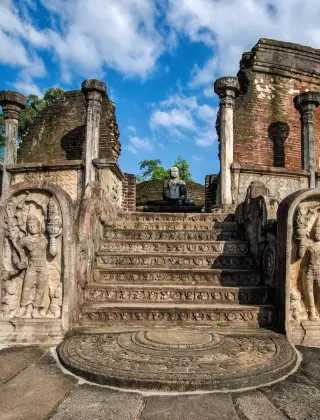
The most architecturally significant building in the quadrangle is the Vatadage, a circular relic shrine built on two concentric stone platforms. The lower platform is 37 metres in diameter, the upper 24 metres. Four ornate entrances face the cardinal directions. The moonstones at the entrances are among the finest surviving examples of Sinhalese decorative stonework: semicircular carvings with concentric bands of geese, horses, lions, elephants, and flames. Stand at the east entrance and look toward the central stupa, which still has four seated Buddha figures at its base facing each direction.
Also in the quadrangle: the Atadage (the oldest surviving structure in Polonnaruwa, built by King Vijayabahu I in the 11th century), the Hatadage (another tooth relic house), the Latha Mandapaya (a small pavilion with distinctive lotus-bud columns), and the Satmahal Prasada, a seven-tiered square tower whose architectural style is distinctly different from Sinhalese Buddhist forms and suggests South Indian or Burmese influence.
The Royal Palace

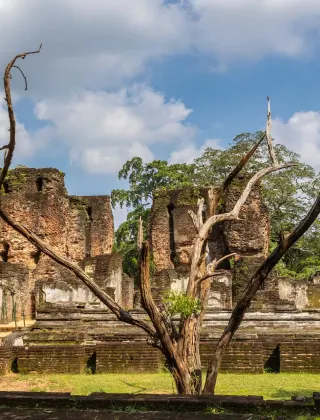
Parakramabahu I's palace was a seven-storey structure measuring 31 metres by 13 metres, with walls three metres thick. The chronicles record that it contained around 1,000 chambers across its seven floors. What remains are the lower two or three levels of the outer walls, with the holes for wooden floor beams still visible in the stonework. The scale of the remaining walls gives an accurate idea of how large the building was, even without the upper floors.
The audience hall adjacent to the palace has a particularly well-preserved stone floor and entrance stairway with elephant carvings. Standing in the courtyard and looking at the three-metre-thick walls, you can work out approximately where each floor would have been from the beam holes.
Rankoth Vehera

The Rankoth Vehera is the largest stupa in Polonnaruwa, standing 55 metres high. It was built by King Nissanka Malla (who reigned after Parakramabahu I, from 1187 to 1196 AD) and is modelled on the Ruwanwelisaya stupa at Anuradhapura. The name means "Gold Pinnacle Stupa." It is the fourth largest stupa in Sri Lanka overall.
Unlike the restored white plaster of the Ruwanwelisaya or the unrestored red brick of the Jetavanaramaya at Anuradhapura, the Rankoth Vehera sits at an intermediate state: partially restored, with the dome visible but not gleaming white. The surrounding terrace and the four shrines at the cardinal points give a clear sense of how this type of structure was used in religious practice.
Lankatilaka

The Lankatilaka is a standing brick shrine house built by Parakramabahu I to house a colossal standing Buddha figure. The walls of the shrine still stand over 17 metres high, though the roof has long since collapsed. The standing Buddha inside is over 14 metres tall at the surviving section; the head was lost when the upper section of the building fell.
The name means "Ornament of Lanka." The scale of the remaining walls, with their thick brick courses and narrow slit windows, creates an unusual interior atmosphere: open to the sky but enclosed enough to feel like a hall. The headless Buddha surrounded by the crumbling but still-standing walls is one of the more striking sights in the Polonnaruwa circuit.
Gal Vihara

The Gal Vihara is the reason to come to Polonnaruwa. Four Buddha figures were carved directly from a single granite gneiss face, 52 metres wide and about 10 metres high, during the reign of Parakramabahu I in the 12th century. The carving was not done by adding material to the rock; the figures were cut from the rock itself, which means any flaw in the granite face would have destroyed the work.
The four figures, from left to right as you approach:
Smaller seated Buddha: 1.4 metres high, housed within a small shrine cut into the rock face, with a decorated arch carved around the entrance
Large seated Buddha: 4.6 metres high, in a standard meditation posture, carved in the open with a decorative halo and flanking figures
Standing Buddha: 6.9 metres tall, standing on a lotus pedestal, arms folded in front of the body in a posture not standard in Indian Buddhist iconography. One widely held interpretation is that the figure represents Ananda, the Buddha's closest disciple, grieving for his master whose parinirvana is depicted in the adjacent reclining figure. Others interpret it as the Buddha himself in a posture of compassionate sorrow
Reclining Buddha: 14.1 metres long, depicting the Buddha entering parinirvana (final enlightenment at death). The subtle smile and the relaxed posture across 14 metres of stone are the technical achievement that makes this figure the highlight of the site
Photography is permitted. The site is managed with low-impact visitor infrastructure: no roof, no barriers beyond the viewing path. Remove shoes before entering the paved area in front of the figures. Come before 9am to see the figures with soft morning light and minimal crowds.
Parakrama Samudra

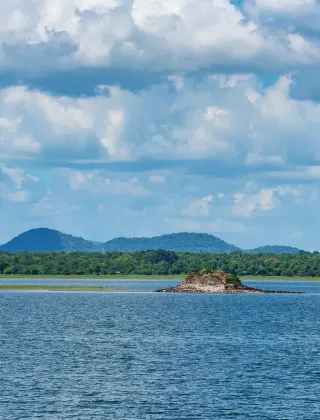
The Parakrama Samudra, the Sea of Parakrama, is the 2,400-hectare reservoir that Parakramabahu I built to store monsoon water for the dry months. It still irrigates approximately 8,100 hectares of paddy fields in the Polonnaruwa district. The earthen bund that holds the water runs for about 14 kilometres.
The reservoir is visible from the main road running south through Polonnaruwa town. The view across the water at late afternoon, with the ruins and bund in the background, is the standard image associated with Polonnaruwa. Most visitors see it from the road; you can also walk a short section of the bund if you want to be closer to the water. There are monitor lizards and water birds along the bank year-round.
Bicycle Route Through the Ruins
A practical circuit from the museum entrance covers the main sites in roughly this order:
Archaeological Museum (30 minutes; do this before cycling)
Royal Palace complex and Audience Hall (10 minutes from museum)
Sacred Quadrangle / Dalada Maluwa (5 minutes further; allow 30 to 45 minutes)
Rankoth Vehera (10 minutes north)
Lankatilaka (5 minutes further)
Gal Vihara (5 minutes further north; allow 30 to 45 minutes)
Return south along the main road past the Parakrama Samudra
The circuit roads are paved and flat. The main challenge is heat, not terrain: the ruins have minimal shade, and cycling between noon and 3pm in the dry season is uncomfortable. Plan to complete most of the circuit by 11am and take a break during peak heat, or start at 7am and finish by early afternoon.
Minneriya and Kaudulla National Parks

Minneriya National Park is approximately 20 kilometres from Polonnaruwa and is the site of one of Asia's largest wildlife gatherings. Between July and October, wild elephants from across the surrounding jungle converge on the receding shores of Minneriya tank as the water level drops and fresh grass is exposed. Gatherings of 150 to 300 elephants have been recorded in a single evening. This event, called "The Gathering," is one of the largest concentrations of Asian elephants anywhere in the world.
A safari jeep to Minneriya from Polonnaruwa takes roughly 45 minutes and costs approximately USD 40 to 60 per jeep (including park entry fees) for a 3-hour afternoon safari. October is typically the peak month for large gatherings. Kaudulla National Park, 30 kilometres north of Polonnaruwa, hosts a similar smaller gathering when Minneriya's water rises again, typically from November to January.
If you are visiting the Cultural Triangle in July, August, September, or October, scheduling one night in Polonnaruwa specifically for a Minneriya evening safari is a practical use of your time.
Getting to Polonnaruwa
From Colombo: Approximately 4 to 5 hours by private car. Intercity buses run from Colombo to Polonnaruwa; journey time approximately 5 to 6 hours
From Kandy: Approximately 2.5 to 3 hours by private car
From Sigiriya: 1 to 1.5 hours by private car
From Dambulla: Approximately 1.5 hours by private car
From Anuradhapura: Approximately 2 hours by private car, typically via Habarana
Polonnaruwa town has a small range of guesthouses and mid-range hotels. Most visitors stay one to two nights and combine the ruins with a Minneriya safari. The town itself is functional rather than scenic; the value is proximity to the ruins and the national park.
Cultural Triangle Combination
Polonnaruwa, Sigiriya, Anuradhapura, and Dambulla form the core of the Cultural Triangle. A four-day route based at Habarana or Sigiriya covers all four sites without long daily drives: day one at Sigiriya and Pidurangala, day two at Polonnaruwa with a Minneriya safari in the afternoon, day three at Anuradhapura, day four at Dambulla Cave Temple before continuing to Kandy or Colombo.
CeylonExplora arranges Cultural Triangle tours with private drivers and local guides at each site. Get in touch if you want the route planned and transport arranged before your trip.



From Fellow Travellers
Comments
No comments yet
Been here, or planning your own trip? Share your experience below and help the next traveller.
Leave a Comment
Comments are reviewed before publishing. No links, please. Email is optional and never shown.